
Strategic Website Usability

Search Without SERPs: The Future of SEO?

Yesterday was Google's 10th anniversary, and I thought it would be a good time to write about something I've been thinking about a lot lately: the humble SERP. Even as Google reinvented how pages were ranked and changed the SEO game forever, the search engine results page (SERP) remained virtually the same. Consider this search result from Lycos, circa 1996 (courtesy of the Internet Archive):

Lycos search

Looks pretty familiar, doesn't it? It's only been the past couple of years where we've begun to see the evolution of the SERPs, an evolution which seems to recently be accelerating. Even putting aside advertising, such as Google's mind-bogglingly profitable AdWords program, search results have started to become customized, personalized, segmented, and have even begun to leave the SERPs altogether.

Enhanced SERPS

This first step in this evolution was search enhancement, when search engines began to add customized features to the SERPs to supplement the basic text results. I'll briefy discuss two, Google OneBox and Google Suggest.

Google OneBox
Back in 2006, Google started experimenting with the OneBox, an area at the top of the SERPs that contained customized information for certain kinds of queries, such as movie showtimes and stock quotes. Probably most notably, OneBox revolutionized the landscape for local search, providing integrated local business listings with Google Maps.
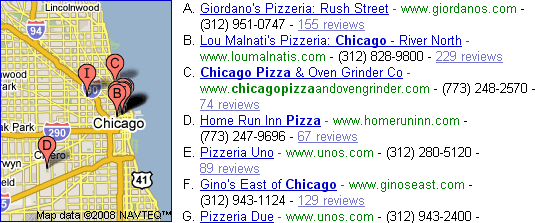
Google OneBox

Pardon the large image, but it really serves to illustrate how much SERP real-estate the OneBox consumes and just how fundamentally it changed the game for searchers and search marketers in certain niches.

Google Suggest
Recently, Google rolled out Google Suggest, a pop-up menu that suggests alternative search queries while you type. For example, when I typed in "chicago pizza" on the Google home-page, I saw this:
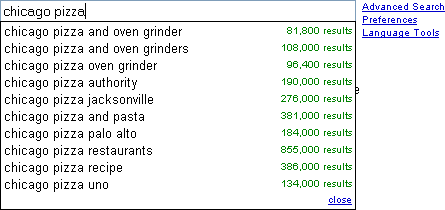
Google Suggest

While Google Suggest still seems like a work in progress, what's notable about it is that it potentially bypasses the first round of SERPs entirely, redirecting a searcher from one set of results to another without even seeing the original listings.

Search Without SERPs

Recent advancements go far beyond SERP enhancement, though. Lately, with technological advances in mobile devices and a resurgence in competition in the browser market, we're starting to see alternatives to the traditional search results.

Mobile Maps - iPhone
I'm a recent iPhone convert - I'll spare you the gory details, but one selling point for me was the integration of GPS. The iPhone 3G comes with a customized Google Maps application with built-in search, but instead of traditional SERPs, you get something more akin to the OneBox map:

iPhone map

Unlike the OneBox, though, the traditional SERP is completely gone, replaced with an interactive map based on your current location. This is obviously useful to end-users, but it changes the game completely for local businesses. If your business isn't ranking for local searches, an iPhone user probably won't find it, even if you rank well on traditional SERPs.

Direct Queries - Ubiquity
Mozilla Labs, creators of the Firefox browser, recently released Ubiquity, a tool for entering simple, customized text queries. For instance, if I call up the Ubiquity plug-in and type "map chicago pizza", I get a search preview:

Mozilla Ubiquity

Once again, results seem to be pulling from the Google Maps/OneBox data, but just as with the iPhone map, Ubiquity has completely circumvented the traditional SERPs.

Implications for SEO

As search marketers, it's hard not to be a little worried by these recent changes - as a group, these advancements are undeniably game-changers and represent a significant learning curve. The important thing to remember, though, is that this evolution is not only good for users, it can be good for clients if we're willing to adapt. SEO is a young field that is destined to break into niches and specialties, and how you best guide searchers to information will depend more and more on your clients and target industries.

Update (Sept. 10): On a similar topic, interesting post from Aaron Wall at SEOBook about how Google Chrome may change SEO. Google's new browser includes the Omnibox, which bypasses SERPs, in some cases.

Dana Lookadoo

 · Tuesday, September 9
Appreciate your insight and timeline of Google's last 10 years! No SERPs? I had not thought of it in these terms. Nice job!

Honestly, all the changes can feel overwhelming. A colleague recently said he felt he was in a tornado trying to figure it all out! This is an excellent opportunity for those in the industry to adapt and excel in their areas of strength.

Your final words summarize it best,
"SEO is a young field that is destined to break into niches and specialties, and how you best guide searchers to information will depend more and more on your clients and target industries."

Dr. Pete

 · Tuesday, September 9
@Dana - It definitely can be unnerving, especially when many of us are already struggling on a lot of different fronts to do the best work for our clients. I think the best we can do is step back and realize that many of these developments are positive, and then try to see the opportunity within our particular niches.

Hjortur Smarason

 · Tuesday, September 9
It's an interesting development. It's with this like any other changes, some problems while others see opportunities. So let's explore the new opportunities this opens up.

MiriamEllis

 · Tuesday, September 9
Nice article, Dr. Pete.

I think so much of this has become about knowing which pursuits to recommend to which clients. Local is an especially good example. Maybe it's always been about this, but the more segmented the web - and especially Google - becomes, the more awareness SEOs have got to develop regarding the right places for their clients to expend effort.

I enjoyed this article.
Miriam

Dr. Pete

 · Tuesday, September 9
Thanks, Miriam - I definitely think we're seeing the pace of change in this area accelerate. I actually cut this post short; it originally had a section on "browserless browsing" that goes even beyond the SERP changes. That might become next week's post.

Craig Ballinger

 · Wednesday, September 10
I haven't seen Ubiquity before, wow, how cool is that? I love that they allow developers to share custom commands. They already have a pretty decent list. The custom php command will definitely come in handy.

Internet Marketing Joy

 · Wednesday, September 10
I don't know how this may be possible but for me, as long as there are sites that were made everyday..the future of SEO will still be bright.

Brian Carter

 · Wednesday, September 10
Ya we end up doing double duty:

1. Keep up with the changes, getting clients into local and long tail etc that they don't really get yet, while also doing well in SERPs they do care about.

2. Trying to educate the clients, which takes forever- client education seems to be naturally slower than the pace of changes in search. Feeling more and more that effective education is crucial to our job.

Jim

 · Thursday, September 25
Nice post, that brings things into perspective at least for me. Thanks!

I am especially interested in techniques for fine tuning Google local results... is there a thread that discusses this?
I had thought that just ranking high in the normal SERPs for a keyword would automagically translate into high placement in the local results (assuming the local registration steps have been followed) but that does not appear to be the case. Any thoughts?

Thanks!

Jim

Dr. Pete

 · Thursday, September 25
@Jim - Ranking in the normal SERPs certainly doesn't hurt, but the local search game is changing rapidly. I don't claim to be an expert, but my friend David Mihm did a great post recently on local ranking factors, where he interviews search experts on what they think are the most important factors for local search. It's a little bit technical, but full of great information.

Ivan - Pizza SEO

 · Sunday, September 28
I think as search marketers the important thing to keep in mind is that whatever way Google (and one day possibly its competitors) change the look of the results, being in the top 3 (5, ..., x) results is going remain very valuable. Many of the ranking factors will still be general and not industry specific. Those who can keep up with SERP developments probably need not be worried about their future. On the other hand, SEOs stuck in the old pre-onebox days with their methodology will become obsolete as the value of their services erodes.

Make Money On The Internet

 · Wednesday, October 8
There is no doubt that SEO has a booming future.. as organic searches always gives benefit with no cost.. also stuffs like Social Media optimization(SMO) has done most of the tricks for webmasters.

Jon

 · Friday, October 10
I see these as positive developments for SEOs who keep up with the changes. As the credit crunch bites, more SMBs are looking at marketing on the internet to give them better ROI. SEOs with a good understanding of local search may find their client-base expanding!

MontrealMan

 · Tuesday, November 18
Google suggestion tool is very cool. Although it sometimes give funny results. Some of these example on http://www.espresso-interactif.com/blog/2008/11/18/google-search-suggestion-tool/

Post a Comment:

Name*:
Email*: (not displayed)
Website:
Send me follow-up comments by email
Comment:
©2008 User Effect, Inc. · Blog · About · Services · Contact · Resources · Archive · Subscribe